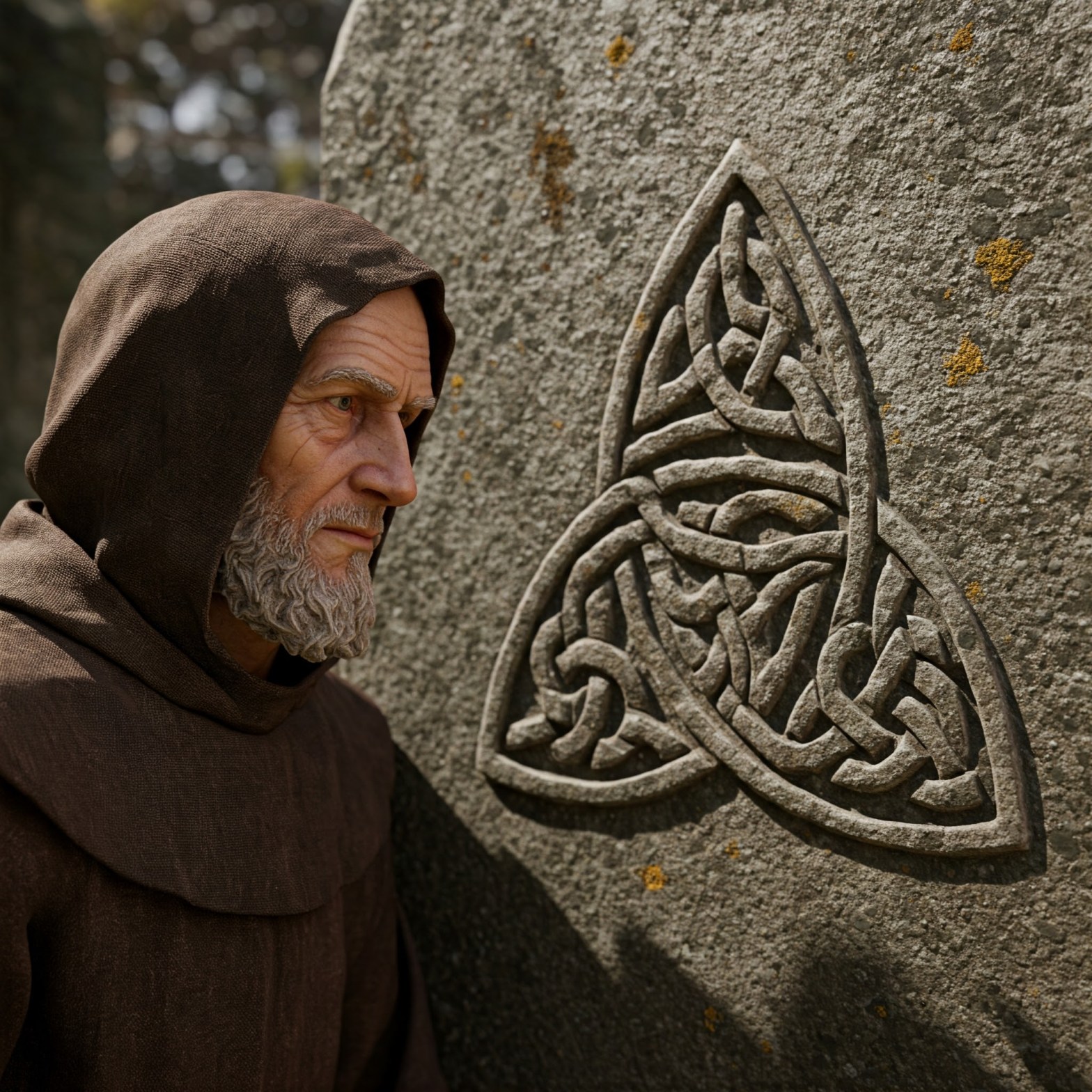
I know this may surprise some of you, but I do not have a tattoo. I know it’s weird for a modern pastor not to have a man bun, tattoo, and skinny jeans, but I don’t. Well, I do have skinny jeans. If I were ever to get a tattoo, it would be a Celtic Trinity knot or maybe my favorite name of God in Hebrew (I AM), but mostly the knot. I am of Scottish/Irish descent. I love the look and the affirmation that I am strongly Trinitarian.
I live in Kentucky, where there is a large group of Christians who deny the Trinity. These groups may be referred to as “Oneness,” “Jesus Only,” “modalists,” or the classical term “patripassianism.” (See The Story of Christianity Vol. I by Justo Gonzalez.) This is not a new belief. It originated from a priest named Sabillius who lived in third-century Rome. He believed that the Trinity is not three distinctive persons that make up the Godhead, but that the Father, Son, and Holy Spirit are all expressions or manifestations of Jesus…thus the term Jesus only.
Sabillianism resurged in the early 1900s as a new wave of Pentecostalism spread from the Parham School in Topeka, KS, and even more so from the Azusa Revival in LA. Charles Parham saw the first person in modern history baptized in the Holy Spirit with the evidence of speaking in tongues: a young lady named Agnes Ozman. She was a student at Parham’s school. Later, William Seymour, the leader of Azusa, also attended this school. However, Seymour was not baptized in the Holy Spirit until later. (Prayer that Ignites Revival by Joe Oden.)
Though Seymour received formal training from Parham, it did not take long before the two broke apart. Why? Sabillianism! Parham began to question the doctrine of the Trinity and expounded the “Oneness” gospel. Seymour denied the denial, holding firmly to the historical, and I might add Biblical, approach to the Trinity. We can see the obvious representation of the Trinity at Jesus’ baptism. (For fun reading, find the Oneness explanation of that event 😊)
Parham is not necessarily regarded as the father of the Oneness church, but his doctrines did influence its later formation. The United Pentecostal Church International’s website states, “The UPCI emerged out of the Pentecostal movement that began with a Bible school in Topeka, Kansas, in 1901 and with the Azusa Street Revival in Los Angeles, California, in 1906. It traces its organizational roots to 1916, when a large group of Pentecostal ministers began to unite around the teaching of the oneness of God and water baptism in the name of Jesus Christ.” The UPCI was formed in 1945 by merging two Oneness denominations. https://upci.org/about-the-upci/
So, can a Oneness Pentecostal be saved if the early church regarded Sabillianism as a heresy and worked to affirm Trinitarian doctrine? You may remember that I made a statement in the affirmative in my last blog. This is a very tricky question. There is more to Sabillianism than this single tenet, but let’s address the Oneness doctrine for a moment.
I sat under an amazing theology professor while in Bible College. Now, with the Lord, Dr. Purdy challenged us to think about this issue. Always the devil’s advocate, he would point us to two Scriptures.
Romans 10:9 says, “If you openly declare that Jesus is Lord and believe in your heart that God raised him from the dead, you will be saved.”
Here we understand that salvation is through Jesus Christ. Granted, the Holy Spirit plays a role. The act of salvation is through the atoning work of Jesus and our faith and trust in Him. If we apply this verse to Oneness theology, we can see they are saved.
Lest you think it’s that easy, read Matthew 12:31-32 “So I tell you, every sin and blasphemy can be forgiven—except blasphemy against the Holy Spirit, which will never be forgiven. Anyone who speaks against the Son of Man can be forgiven, but anyone who speaks against the Holy Spirit will never be forgiven, either in this world or in the world to come.” From this verse, one could argue that not believing in the person and work of the Spirit is blasphemy. Unfortunately, Jesus does not give us any details to help us here. We do not fully understand the nature of the word “blasphemy” in this context.
So then, why would I say that I believe people holding a Oneness theology are saved? The short answer is Spiritual Fruit and a sense of God’s presence when I am around them or see a service, whether it is Charity Galyle or a service with the Pentecostals of Alexandria. Ultimately, I am very thankful that God has to make that call, not me. It does make me think of the scripture about sin…it’s another tough one. 1 John 5:16-17 “If you see a fellow believer sinning in a way that does not lead to death, you should pray, and God will give that person life. But there is a sin that leads to death, and I am not saying you should pray for those who commit it. All wicked actions are sin, but not every sin leads to death.” “Not every sin leads to death.” Is it possible that Oneness theology fits in this space? They genuinely seem to love and honor Jesus, but their theology is wrong, doctrinally and from Church history.
In the end, I will strongly and adamantly Deny their Denial! The Trinity is a sound and proven doctrine. I echo the theme of the Apostle’s Creed: our God is three in one!
The building our church now owns was originally a Oneness church. On the first service here, 20 years ago, I was leading worship. We closed with this beautiful hymn:
Holy, holy, holy!
Lord God Almighty
Early in the morning
Our song shall rise to Thee
Holy, holy, holy!
Merciful and mighty
God in three persons
Blessed Trinity! (Emphasis Mine)
That was, of course, intentional. We are Pentecostal, but we are also unashamedly Trinitarian. Sing it with me loud, “God in three persons, blessed Trinity!” Now and forever!
 Through Time
Reading your words felt like a breath of fresh air—thank you for sharing your heart.
LikeLiked by 1 person
Thank you for reading!
LikeLiked by 1 person
Keep up the great work
LikeLike
Another great post! I’ve really been appreciating this series. It’s been helpful and challenging in all the right ways. This post raised some questions for me around your take on Oneness theology.
You mentioned that some who hold to it might still be saved based on spiritual fruit or sensing God’s presence. I get the pastoral heart behind that, but if the Bible is clear about who God is, and if the Spirit leads us into truth (John 16:13), shouldn’t persistent denial of the Spirit’s personhood be taken more seriously?
Matthew 12 is a tough passage, but the context seems focused on people who knowingly reject and misattribute the Spirit’s work. That’s not just confusion. It looks more like resistance. Hebrews 5:12–14 also comes to mind, where some, though they should be mature, still need milk and remain unskilled in the Word. That hits close to home for Pentecostal contexts, and specifically Oneness groups, where spiritual experience often gets emphasized more than doctrinal formation. That gap might explain why Oneness ideas still find traction.
That’s why this series has meant a lot. I believe, like most Pentecostals, that the Bible is clear. So, if someone denies the Trinity while claiming to be Spirit-led, we either have to treat that as serious error and a false gospel based on sola scriptura, or acknowledge that the Church’s historic tradition plays a necessary role in preserving and articulating core truths—which would still lead us to recognize that denial as heresy. And ironically, that’s something many Protestants are uncomfortable with. Still, if we trust that the Spirit was present at Azusa, we should also trust He was guiding the Church at Nicaea and Chalcedon too.
I’m grateful you’re creating space for these kinds of conversations. Looking forward to the next post.
LikeLiked by 1 person
I plan to write a follow-up to this blog that will explore the legalistic views of salvation by those who hold to Oneness theology.
LikeLiked by 1 person